Charge your car.
Make time for Wrocław.
You don’t always need 80%. You need enough charge to reach your next reliable charging stop, with a reserve — and a plan to get back before parking and time charges eat into the savings.
Work out your target charge. Match it to your day. Choose AC or DC for the stop you actually want.
How much charge do you actually need?
Enter the distance from this charger to your next reliable charging opportunity. Use consumption figures for that journey: motorway driving and city driving are different.
Your car and the next leg
What’s your plan in Wrocław?
Time away from the car = your visit + the walk both ways + your buffer. We don’t assume the charger is right outside the entrance.Adjust the assumptions for your charging stop
Work out the next leg.
Faster charging isn’t always a better fit.
The time range covers two average-power scenarios. The cost includes energy, parking, a session fee and time charges. A subscription is only included if you add its cost to the fixed fee.
Illustrative prices, not an operator’s offer. These figures show how the energy price differs from the total cost of a stop. Enter the actual terms before making your choice.
AC · explore while you charge
ACA longer session gives you more room for your visit.
Full AC pricing terms
DC · top up for the next leg
DCCharging may finish well before your visit does.
Full DC pricing terms
We calculate the stay up to the end of the slower charging scenario or your time away, whichever is longer. For charges after charging ends, we use the earlier session end as a cautious estimate. To stop at the target, set a limit in your car if it supports one, or end the session yourself. If your stay changes, update the total parking charge too.
When should you be back at the car?
Choose AC or DC above. Treat this as a planning time; check the actual session in your car or charging app.
Your card is ready. Save it to your phone or send it to your travelling companion.
Before you leave the charger
Also check the connector, status, price and car park access in the operator’s app. EIPA doesn’t list every charger — for example, some are only for hotel guests.One plug. Three separate charges.
Battery electric cars are exempt in the city’s paid zones.
Fully electric cars are exempt from parking charges in Wrocław’s SPP and ŚSPP municipal zones. That doesn’t cover charging, the operator’s time charges or private car park fees.
Plug-in hybrids do not have the same statutory exemption. Bay signs and parking restrictions still apply.
A 22 kW charger doesn’t make your car charge at 22 kW.
If your car accepts up to 11 kW AC, a higher-rated charge point won’t halve the session. With DC, what matters is the average power during your stop, not the largest number on the charger.
Check your car’s limit, battery temperature and whether the charger shares power.
A charger isn’t a parking reservation.
A short DC session may be over just as your meal arrives. AC may fit a longer visit better, provided the tariff and bay rules allow it.
Move your car after reaching the target if the signs or charge point rules require it.
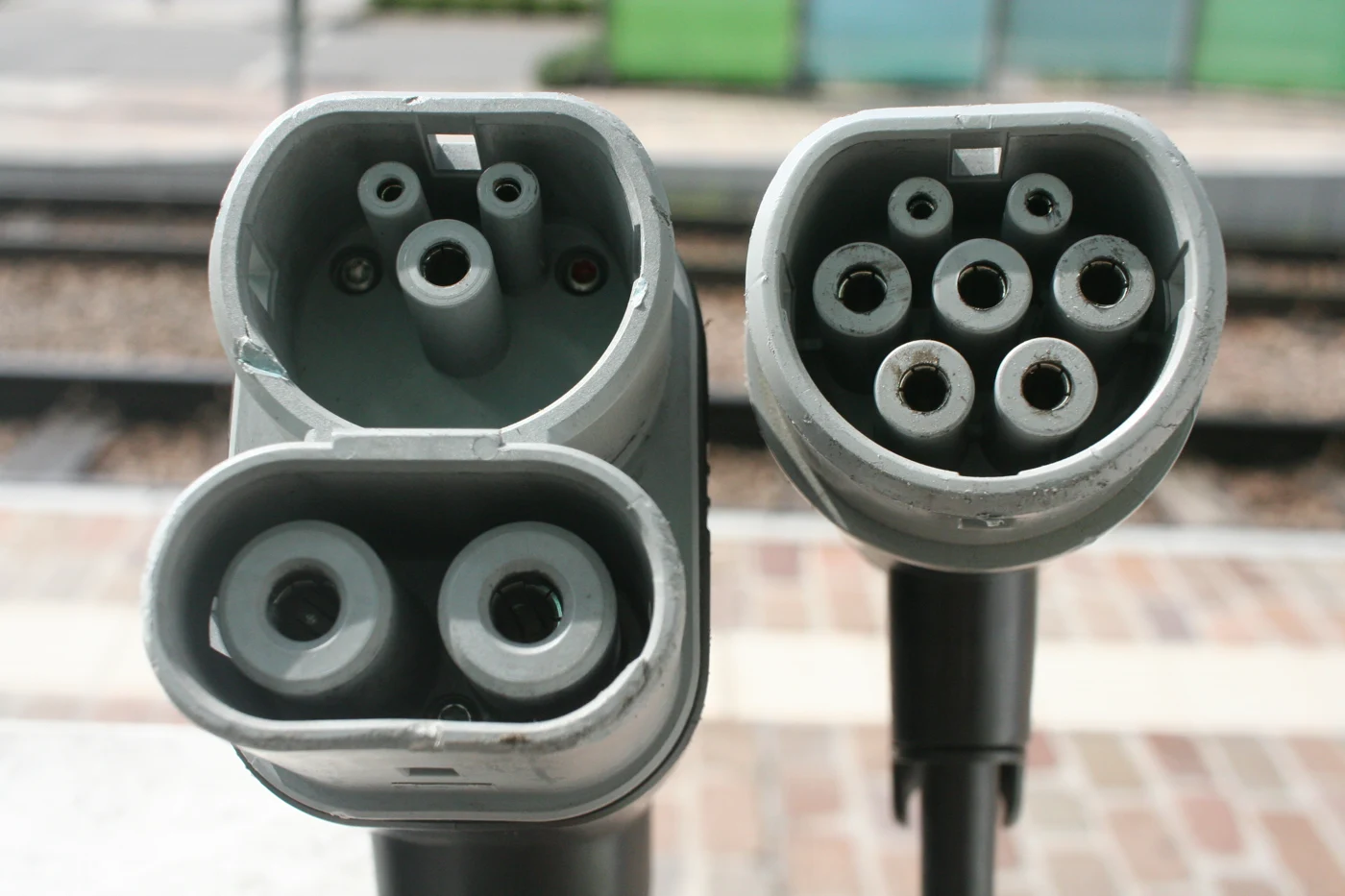
Check the connector.
And bring the right cable.
At an AC Type 2 point with a socket only, you need your own compatible cable. CCS2 has two extra large contacts for DC charging. Not every car supports CCS2: older models may use CHAdeMO or have no DC charging capability.
Filter the map for your car’s connector. A “fast charger” label alone doesn’t tell you whether it will work.
Check the basics before trying another app.
I’m at the charger, but the session won’t start. What now?
Make sure the charge point and connector number selected in the app match the ones next to your car. Check the error message, payment and instructions on the charger. If it still won’t start, call the support number on the unit or use your backup. A busy or faulty charger is not a dependable source of energy for the next leg.
Why is the app price different from the operator’s price?
Roaming, subscriptions and one-off payments can have different terms. Enter the price for the payment method you will actually use to start this session. Check session fees and time charges too. Comparing only PLN/kWh can lead you to the wrong choice.
Can I leave the car charging for my entire zoo visit?
Add up the visit and the walk both ways, then compare that with the charging time and fee threshold. If charging will finish much earlier, plan to move the car, or use a normal parking space and charge before or after the visit. The calculator doesn’t confirm space availability or the rules of a particular car park.
Do I need 100% charge to leave Wrocław?
You need enough energy for the next leg plus your chosen reserve. If the result exceeds 100%, even a full battery won’t meet those assumptions: split the journey into shorter legs. DC often slows at higher charge levels. Allow for the weather and the next charger’s availability rather than adding charge out of habit.
How are the charge target and cost calculated?
Target % = round up (km × consumption in kWh/100 km ÷ usable battery capacity + reserve %). Battery top-up in kWh = capacity × (target − current charge) ÷ 100, with a minimum of 0. Energy from the charger = battery top-up ÷ efficiency. Time = energy from charger ÷ average power × 60.
Total cost = energy from charger × price per kWh + parking for the whole stop + session fee + time charges. We don’t check live prices or availability. The time range reflects the stated power assumptions, not a measurement margin of error.
Sources and photo licence
- ZDiUM — parking exemptions in SPP and ŚSPP; rules for low-emission vehicles.
- UDT / EIPA — register coverage and charge point availability.
- GreenWay — power, connectors, roaming and time charges.
- Tesla — how battery charge level affects DC speed.
- Photo: Paul Sladen, own work, file on Wikimedia Commons, CC0 1.0. The photo shows connectors, not a charging location in Wrocław.
