A SMALL SYMBOL. A BIG STORY.
The story of Wrocław’s dwarfs.
From a protest
to a symbol of the city.
First a drawing. Then a monument.
Finally, the little figures you meet on a walk.
The images illustrate three stages. The dates refer to the symbol’s history; photo details appear in the chapters below.
THE STORY IN 30 SECONDS
Where did Wrocław’s dwarfs come from?
Their modern story connects the Orange Alternative’s actions in the 1980s, the Papa Krasnal monument of 2001 and the first series of small sculptures in 2005. Graffiti, monument and miniatures mark different stages: protest, remembrance and discovering the city.
Sources: Małgorzata Skotnicka-Palka · Ewa Chabros · Paula Pater · Tomasz Moczek on how the project began
FIVE MOMENTS WORTH KNOWING
See how the meaning changed.
GRAFFITI
1982
30/31 August 1982
It began with a patch of paint.
The first Orange Alternative dwarfs in Wrocław were painted by Waldemar “Major” Fydrych and Wiesław “Rotmistrz” Cupała. Ossolineum’s account places them on the night of 30–31 August 1982, on a transformer box in Sępolno and the wall of a block of flats in Biskupin.
The drawings appeared on patches left where opposition slogans had been painted over. A dwarf turned the trace of censorship into a new, mischievous message.
Sources: Małgorzata Skotnicka-Palka
Link to this chapter ↗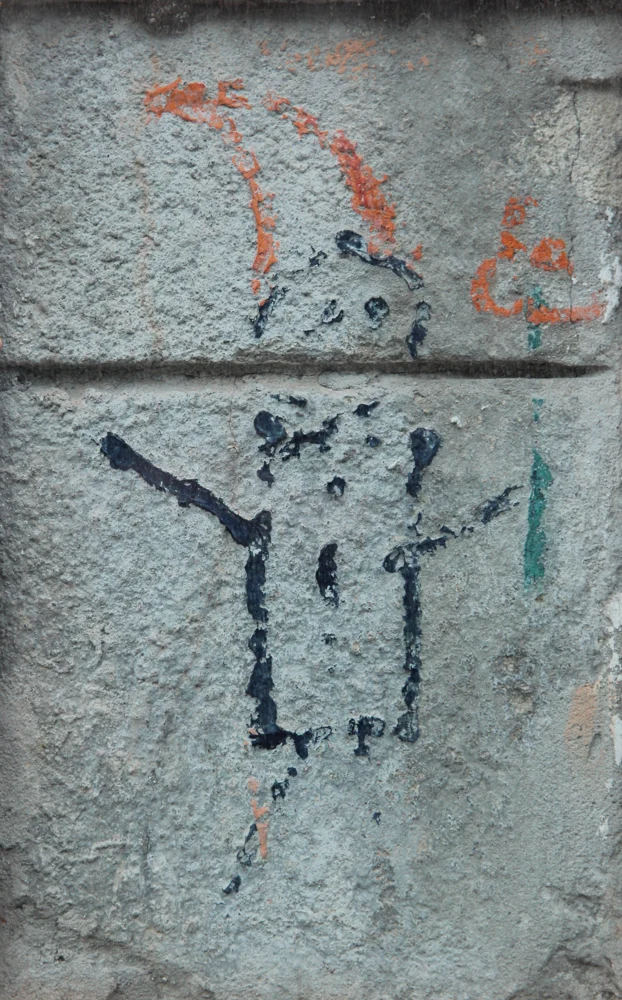

HAPPENING
1987
1 June 1987
The dwarfs take to the streets.
According to the Encyclopaedia of Solidarity, “Dwarfs on Świdnicka Street” was the movement’s first mass happening. The Orange Alternative organised it with students involved in the informal Dwunastka student group at the University of Wrocław.
Costumes invited people into a shared performance. Passers-by joined in, while the militia’s reactions laid bare the absurdity of the situation.
Sources: Ewa Chabros
Link to this chapter ↗The first mass happening
“Dwarfs on Świdnicka Street”
THE REVOLUTION OF THE DWARFS
1988
1 June 1988
A city in orange hats.
A year later came the “Revolution of the Dwarfs”. Thousands of people wearing dwarf hats filled central Wrocław. This is the event recalled by the city article featuring a photo of Waldemar Fydrych using a bollard as a megaphone.
The events of 1987 and 1988 were distinct. The first marked a breakthrough mass happening; the second became one of the movement’s best-known images.
How many people took part? Sources give different estimates: the city website says 10,000, while the Encyclopaedia of Solidarity says more than ten thousand. We therefore say “thousands” rather than suggest a precision the records cannot support.
Sources: “36 years ago, 10,000 dwarfs marched through Wrocław” · Ewa Chabros
Link to this chapter ↗PAPA KRASNAL
2001
1 June 2001
The symbol gets a monument.
Papa Krasnal was installed on Świdnicka Street, near its junction with Kazimierza Wielkiego, as a tribute to the Orange Alternative. It was created by Olaf Brzeski.
You can recognise him by the large finger-shaped plinth. This monument commemorates the movement and differs in form and scale from the small figures that came later.
Sources: Paula Pater · Elżbieta Dudek · Olaf Brzeski — artist profile
Link to this chapter ↗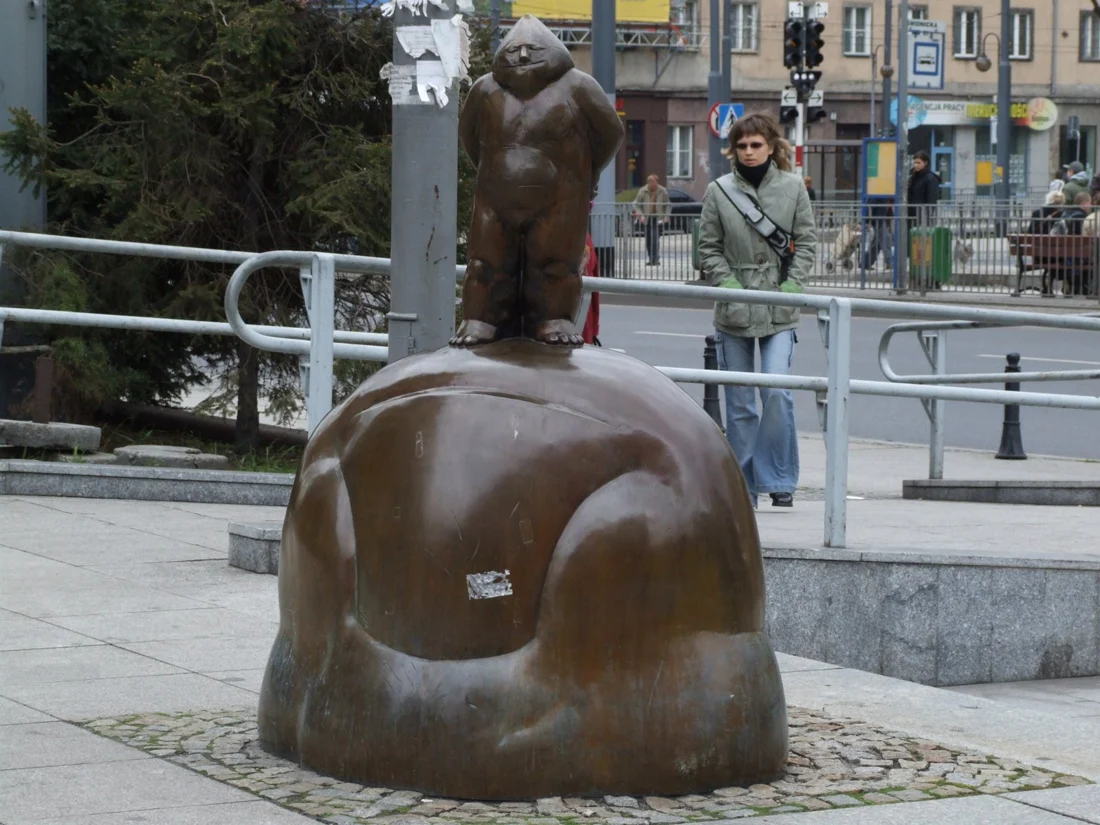

THE FIRST FIVE
2005
August 2005
Small sculptures, a new chapter.
Tomasz Moczek made the first group of miniature dwarfs: Szermierz, Rzeźnik, Pracz Odrzański and the two Syzyfki. That is five figures, although the list has four names.
On visitWroclaw, the sculptor confirms that he began the project in 2005 on commission from the City Office’s Promotion Department. Other artists and studios later joined in creating new figures.
Why do we give the month rather than an exact day?
Paula Pater gives 1 August 2005, while Elżbieta Dudek’s list dated 28 August 2026 gives 3 August. Both sources place the first five in August 2005, so that is the level of precision used in the main timeline.
Sources: Paula Pater · Tomasz Moczek on how the project began · Elżbieta Dudek
Link to this chapter ↗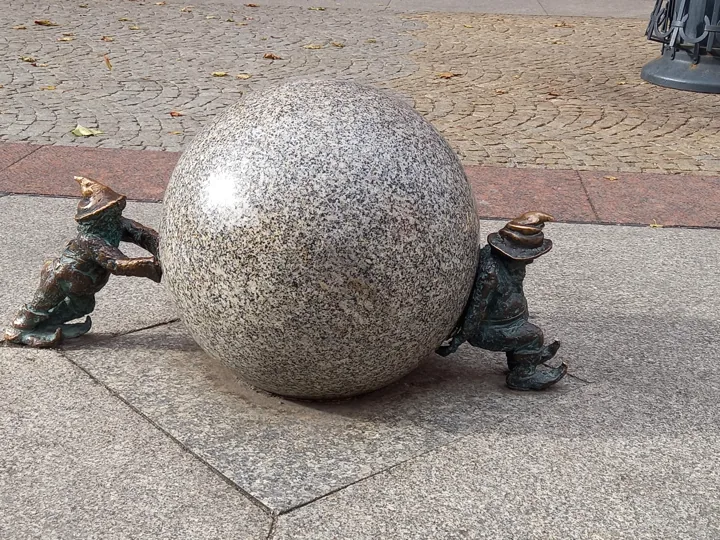
HOW THE IDEA WORKED
Why a dwarf?
Three versions of the same wall show the drawing’s subversive logic.
WroTU diagram. A simplified illustration of the mechanism, not a reconstruction of a particular piece of graffiti.
A message of dissent appears on the wall.
Opposition slogans were a way to speak out in public space.
The words disappear. A trace remains.
Painting over the slogan removed the words but left a visible patch.
The patch takes on a new meaning.
A dwarf drawing used that trace. The joke undercut the regime’s solemnity and invited people to read the situation for themselves.
Sources: Małgorzata Skotnicka-Palka
ONE QUESTION, THREE ANSWERS
Which dwarf was first?
It depends whether you mean a drawing, a monument or a small sculpture.
The start of the graffiti
The night of 30–31 August; Fydrych and Cupała; Sępolno and Biskupin. This is the beginning of the Orange Alternative dwarfs in Wrocław.
Sources: Małgorzata Skotnicka-Palka
See the chapter and photo ↗Papa Krasnal
Olaf Brzeski’s monument, unveiled on 1 June on Świdnicka Street. It commemorates the Orange Alternative.
Sources: Elżbieta Dudek · Olaf Brzeski — artist profile
See the chapter and photo ↗Five figures by Tomasz Moczek
August: Szermierz, Rzeźnik, Pracz Odrzański and two Syzyfki. Papa Krasnal belongs to the earlier phase.
Sources: Paula Pater · Elżbieta Dudek · Tomasz Moczek on how the project began
See the chapter and photo ↗THE PEOPLE BEHIND THE SYMBOL
Who did what?
Fydrych and Cupała
Waldemar “Major” Fydrych and Wiesław “Rotmistrz” Cupała were involved in the earliest dwarf drawings. Many other people helped shape the movement.
Sources: Ewa Chabros · Małgorzata Skotnicka-Palka
Olaf Brzeski
Creator of Papa Krasnal, the Orange Alternative monument on Świdnicka Street.
Sources: Olaf Brzeski — artist profile
Tomasz Moczek
Creator of the first five in 2005. Later dwarfs have many makers, listed in the city’s directory of studios.
Sources: Tomasz Moczek on how the project began · Elżbieta Dudek
EXPLORE THE DOCUMENTS
A small source cabinet.
Three items that take you beyond the short version of the story. Each opens at its original source.

„Dzień Wojska”
Robert Jezierski’s poster invites people to Świdnicka Street. Look at the time, the military motif and the way it addresses the public.
View the document ↗02 / EVENT PHOTO · 1988Major and his “megaphone”
The city article shows a photo from an exhibition at the European Solidarity Centre. An everyday object becomes a prop in a happening.
View the photograph ↗03 / OSSOLINEUM ARCHIVEWhat has survived?
The study describes leaflets, poster designs, photographs and other traces of the movement. Its notes lead to the underlying documents.
Open the study (PDF) ↗A STORY TO TAKE WITH YOU
Remember the three beginnings.
One A4 page: five dates, the people involved, the key distinctions and sources. Useful for reading together, in class or before a walk.
Find a tiny local character.
Choose an area, open clues and look for the dwarfs.
Go to the game ↗NUMBERS AND METHODHow many are there, exactly?
The latest total and an explanation of how we count.
See the count ↗HOW WE RESEARCHED THIS
Sources and verification
We compared historical studies, institutional publications, the sculptor’s own account and a directory of the figures. This is WroTU editorial research, not an eyewitness account. We distinguish the dates of the photographs from the dates of the objects they show.
- Małgorzata Skotnicka-Palka, „My jesteśmy krasnoludki, czyli Pomarańczowa Alternatywa”
Ossolineum, “Czasopismo ZNiO”, issue 29, pp. 75–90. Early graffiti: pp. 79–80; happenings: pp. 81–86.
- Ewa Chabros, „Pomarańczowa Alternatywa”
Encyclopaedia of Solidarity, vol. IV. Names and dates of events, participants and the character of the movement.
- “36 years ago, 10,000 dwarfs marched through Wrocław”
Wrocław city website. Article on 1 June 1988 and a photograph from a European Solidarity Centre exhibition.
- Paula Pater, „Tematyczne formy rzeźbiarskie…”
“Przestrzeń i Forma” 35 (2018). The 2001 monument, the first five and the sculptures’ role in public space.
- Tomasz Moczek on how the project began
Official tourism website: the sculptor’s account of starting work in 2005 on commission from the City Office’s Promotion Department.
- Elżbieta Dudek, „Lista Wrocławskich Krasnali”
Version dated 28 August 2026, entries 1–6: Papa Krasnal, the artists and the first miniatures. The list gives 3 August 2005.
- Olaf Brzeski — artist profile
Lower Silesian Society for the Encouragement of Fine Arts. Attribution of the Orange Alternative monument.
What does the verification date mean?
15 September 2026 is when we compared the sources for this article. It does not mean we made new archival discoveries or confirmed the current condition of every location. The date will change after the next actual review.
Photo credits and licences appear beside the chapters. The wall diagram and date graphics are by WroTU. Documents in the source cabinet open on their publishers’ websites.
Back to top ↑