What actually crossed from one city to the other? Choose a trace, follow its story and test the familiar claim that Wrocław is a “second Lviv”.
journeysA statue can be transported. A library only partly. Knowledge travels with people; a legend can travel faster than all of them.No prescribed walking route. Start with the question that interests you.
Choose a kind of trace
Each card asks what moved, what stayed behind and what you can still see today.
The statue that changed squares
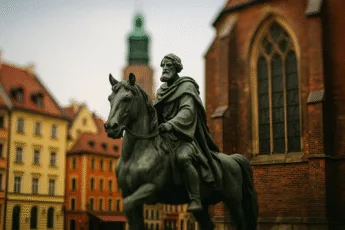
Made for Lviv and unveiled there in 1897, the statue of writer Aleksander Fredro travelled via Warsaw after the war. It has stood in Wrocław’s Market Square since 1956. The bronze is the same; the city around it tells a different story.
 Institution + holdings
A library with a missing chapter
Founded in Lviv, the Ossolineum was re-established in Wrocław in 1946. Shipments in 1946–47 brought roughly 30% of its pre-war collections here. Saying “the library moved” leaves out the fate of most of its holdings.
 Artwork + new setting
The painting that waited decades
The Racławice Panorama opened in Lviv in 1894. Its vast canvas came to Wrocław after the war, but the public could not enter its new rotunda until 1985. The gap between arrival and display is part of the work’s history.
A university does not fit in a crate
Academics linked to Lviv’s universities helped build post-war higher education in Wrocław. Stanisław Kulczyński, once rector of Lviv’s Jan Kazimierz University, became the first rector of the joint University and Polytechnic. Their expertise shaped new institutions in buildings already standing here.
Make your own connection
Save the traces you find compelling and get a short card to copy or share. Explore them in any order: this is a way to think about the city, not a fixed route.
Nothing saved yet. Start with a card above.
Separate memory from myth
Three quick questions. Each answer reveals a detail that changes the picture.
1. Most of Wrocław’s first post-war residents came from Lviv.
False. Around 17,000 people from Lviv settled here in the first two post-war years, less than 8% of the population. Their cultural and academic influence was much larger than their share of residents.
2. All of the pre-war Ossolineum collections came to Wrocław.
False. Roughly 30% arrived. “Relocation” is too neat a word for what happened to the rest.
3. The Racławice Panorama’s rotunda was moved from Lviv too.
False. The painting travelled; the Wrocław rotunda was built here. The exhibition opened in 1985.
Answer all three to see your score.
Two cities, more than one memory
The post-war connection between Lviv and Wrocław includes forced departures, divided collections and the movement of many communities. Wrocław also has centuries of history as Breslau. Lviv remained a living city with its own people and history.
That is why this atlas does not hunt for a “second Lviv”. It follows specific connections while showing the limits of that metaphor. A trace can reveal more than a picturesque landmark.

Sources and image rights
- Ossolineum: re-establishment in Wrocław; fate of the Lviv holdings.
- National Museum in Wrocław: Panorama history.
- City of Wrocław: the journey of Fredro’s statue.
- University of Wrocław: institutional history; Wrocław University of Science and Technology: academics from Lviv.
- City of Wrocław: Lviv newcomers and the academic community.
- Ossolineum photo, rotunda photo, archival Fredro photo. Image rights: the Ossolineum and rotunda photographs were released into the public domain by Michał460. The archival Fredro photograph is by Marek Münz / National Library of Poland and is also public domain.