- The Breslau Murders – quick facts about the series
- What is “The Breslau Murders” and what world does it portray?
- Breslau and Wrocław – what is fiction and what is history?
- Why does the series use the name Breslau instead of Wrocław?
- The city’s atmosphere – noir aesthetics and spatial drama
- Does “The Breslau Murders” help to understand the city’s history?
- Was the series filmed in Wrocław?
- Where can you find traces of old Breslau in today’s Wrocław?
- Frequently asked questions about The Breslau Murders and Breslau
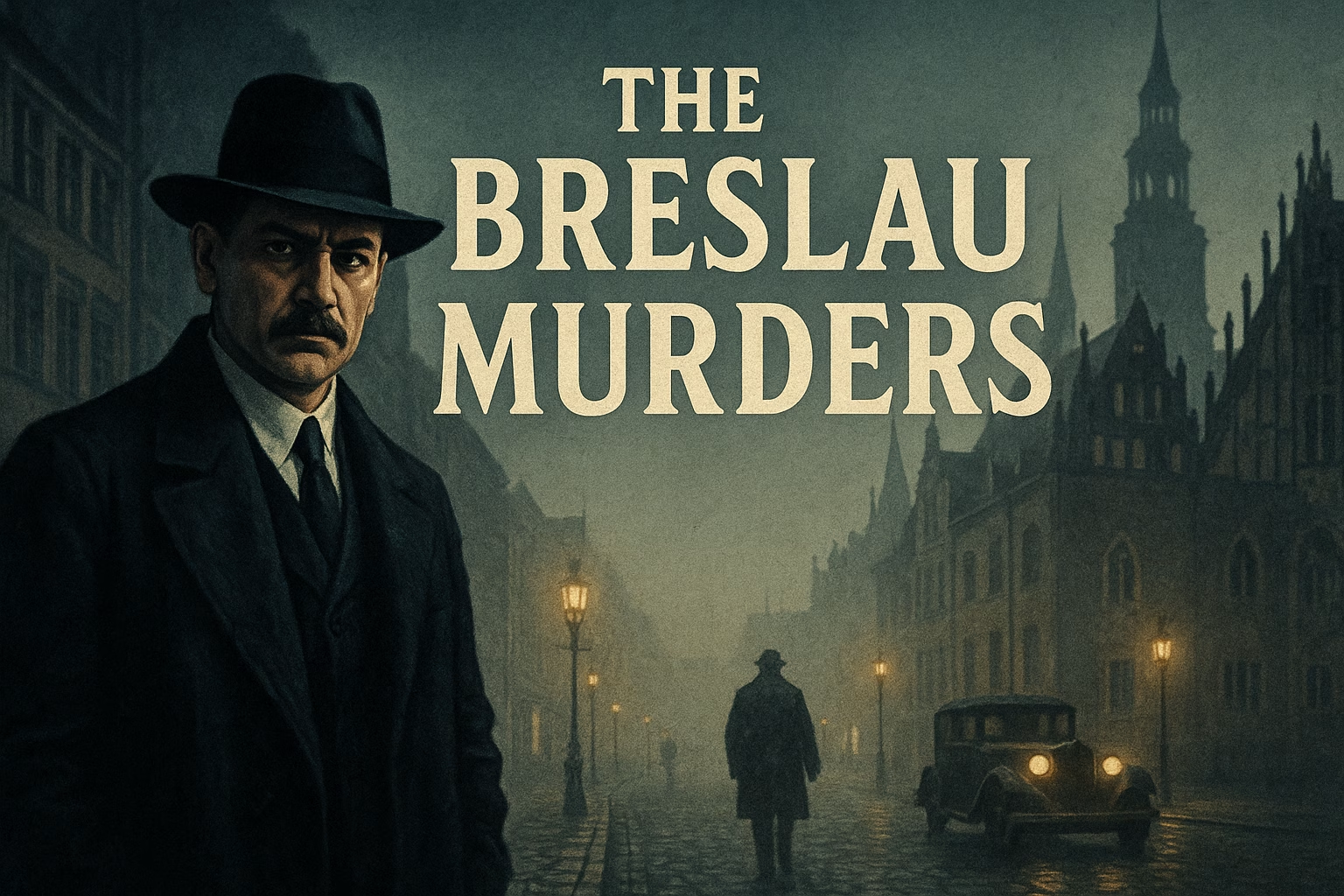
The series The Breslau Murders is one of the more compelling crime productions to bring pre-war Wrocław into the sphere of popular culture. Its title refers to the city’s historical German name – Breslau – immediately transporting the viewer into the dark atmosphere of the 1930s, when Europe was already on the brink of dramatic transformation.
This is not a classic guide to Wrocław, but a fictional narrative in which the city becomes a fully-fledged protagonist of a crime story.
The Breslau Murders – quick facts about the series
- Genre: historical crime / noir
- Time period: 1936
- Setting: pre-war Breslau (today’s Wrocław)
- Main theme: a series of brutal murders threatening the image of the Third Reich
- Main character: Franz Podolsky – a police commissioner of Polish origin
- Visual style: dark noir aesthetics, strong urban symbolism
What is “The Breslau Murders” and what world does it portray?
The series is set in 1936, when the city still functioned under its German name, Breslau. In the background, political tensions are rising and the growing control of the Nazi regime is increasingly visible, as preparations for the Olympic Games unfold and the state seeks to maintain the image of an efficiently functioning power.
The main character is Franz Podolsky, a morally ambiguous yet highly effective police commissioner who becomes entangled in an investigation into a string of brutal murders. The case quickly proves far more complex than an ordinary crime spree – intertwining with propaganda mechanisms, political pressure and a mounting sense of threat.
The series builds tension not only through its plot, but also through its portrayal of the city – as a space of unease, hidden conflicts and social fractures.
Breslau and Wrocław – what is fiction and what is history?
Breslau is not a fictional name, but the historical designation of today’s Wrocław, used until 1945. However, the city as depicted in the series is an artistic interpretation of the era – combining authentic historical realities with a fictional crime narrative tailored for dramatic storytelling.
The creators draw on characteristic elements of the urban landscape: monumental buildings, narrow streets, hotels and interiors styled to the 1930s, highlighting the city’s ambivalent identity as a borderland – between modernity and ideology, order and growing chaos.
Viewed through the series, Wrocław is not merely a backdrop, but a carrier of meaning: a witness to social change and the moral dilemmas faced by its characters.
Why does the series use the name Breslau instead of Wrocław?
The use of the name Breslau is a deliberate narrative and historical choice. It signals to the viewer that the story takes place before World War II, when the city functioned within a completely different political, linguistic and cultural framework.
For an international audience, the title The Breslau Murders sounds mysterious and deeply historical, evoking the atmosphere of old Central Europe. At the same time, it clearly separates the series’ reality from contemporary Wrocław – a modern Polish city that has preserved the urban structure of its earlier incarnations but now operates within an entirely different social order.
The city’s atmosphere – noir aesthetics and spatial drama
“The Breslau Murders” draws heavily on noir aesthetics, in which the city takes on an almost symbolic role. Dark frames, high-contrast lighting, smoke-filled interiors and claustrophobic alleyways create a sense of entrapment and uncertainty.
Breslau is depicted as a place full of tension – formally ordered yet internally unstable. This vision perfectly complements the central conflict between the individual and the system, between morality and submission to the mechanisms of state power.
It is this atmosphere, rather than the crime plot alone, that makes the series memorable and distinct from other historical productions.
Does “The Breslau Murders” help to understand the city’s history?
Although the series is neither a documentary nor a historical reconstruction, it can serve as a valuable starting point for reflection on Wrocław’s past. It portrays the city at a pivotal moment – just before events that would completely redefine its identity.
Through this narrative, viewers may more easily perceive the urban and cultural continuity of a place that, despite changing borders, languages and populations, has retained its character. Wrocław emerges as a city with a complex, multi-layered history, traces of which remain visible in its architecture and urban fabric.
Was the series filmed in Wrocław?
Although the story is set in 1930s Breslau, not all scenes were filmed in authentic Wrocław locations. The production uses a combination of selected real settings and carefully stylised sets created to evoke the atmosphere of the period.
For the creators, the key objective was to recreate the mood and spirit of the pre-war city rather than to provide a faithful documentation of specific addresses. As a result, viewers are presented with a symbolic vision of Breslau that captures the essence of the era rather than a precise historical map.
Where can you find traces of old Breslau in today’s Wrocław?
Walking through the Old Town, around the Market Square, the University of Wrocław, Ostrów Tumski and former residential districts, one can still encounter architecture dating back to the Breslau era. Preserved tenement houses, public buildings and the historic street layout form a tangible record of the city’s centuries-long history.
The series can inspire a more conscious way of exploring the city – not only through the lens of tourist attractions, but as a journey through layers of memory and identity. Wrocław ceases to be merely a weekend destination and becomes a space where history remains present in its details, walls and urban landscape.
The series The Breslau Murders demonstrates how popular culture can reinterpret a city’s complex past and transform it into a narrative that intrigues, unsettles and encourages a deeper understanding of Wrocław. It is not a substitute for a museum visit or a guided tour, but a compelling starting point for those who wish to view old Breslau through a broader cultural and historical lens.