- What is the Penitent Bridge?
- Where does the name “Witches’ Bridge” come from?
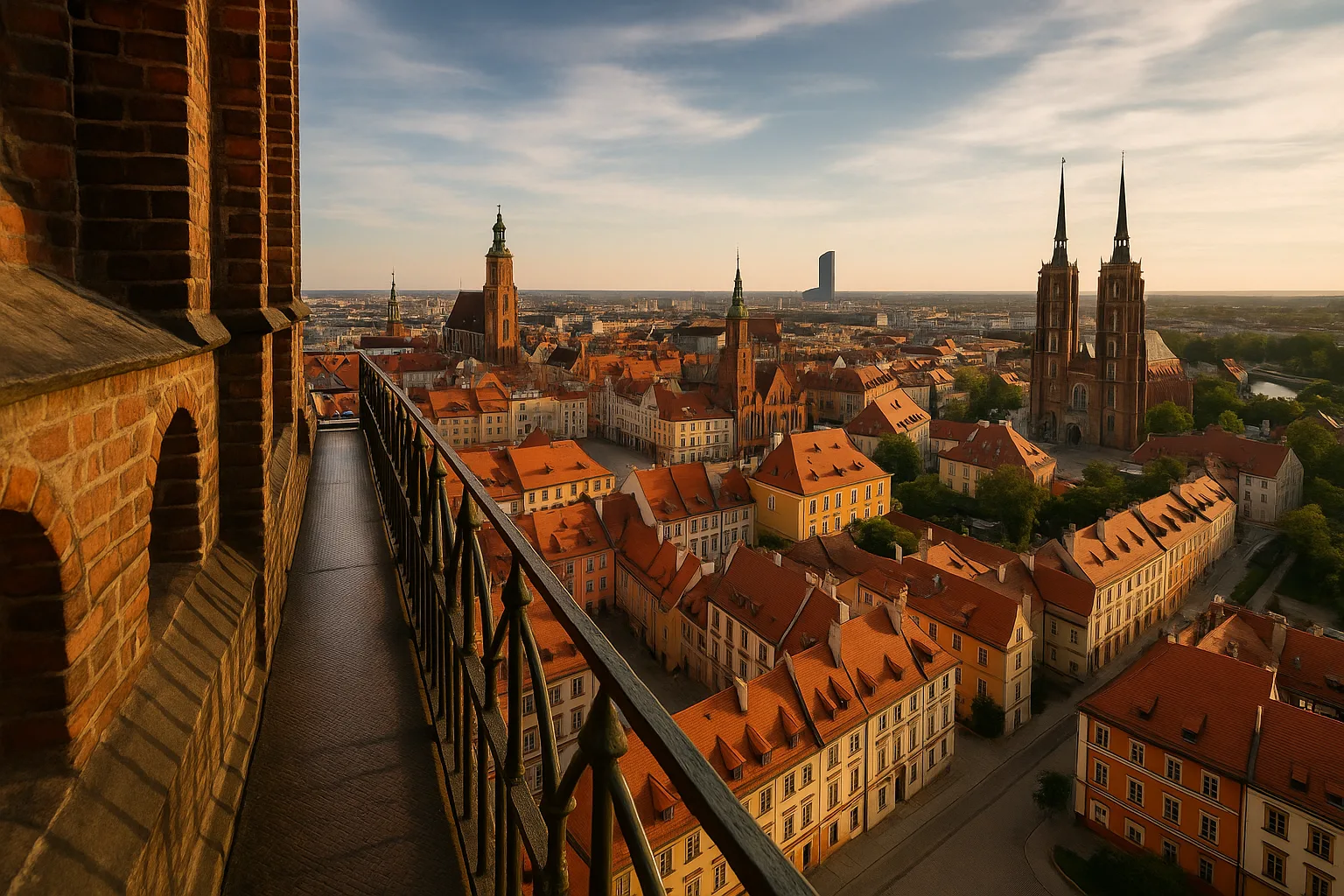
- The view from the Penitent Bridge – what can you see?
- Is the Penitent Bridge open to visitors?
- When is the best time to visit the Penitent Bridge?
- Visiting the Penitent Bridge with children or seniors
- Where is the Penitent Bridge located?
- The Penitent Bridge and other viewpoints in Wrocław
- Is the Penitent Bridge worth visiting?
- Penitent Bridge – interesting facts
- FAQ – Penitent Bridge in Wrocław
Penitent Bridge is a medieval passage connecting the two towers of St. Mary Magdalene Church in Wrocław. It is known for its “witches’ bridge” legend and for its panoramic views over the Old Town. The bridge is located in the city centre of Wrocław and is open to visitors.
Penitent Bridge, also known as the Witches’ Bridge, is one of the most distinctive attractions in Wrocław. Suspended high between the two towers of St. Mary Magdalene Church, this stone walkway combines the city’s history, local legends and a unique viewpoint over the Old Town.
For visitors, it’s a short but content-rich stop – in just a few minutes you can learn the story behind the place, enjoy the city panorama and experience the medieval atmosphere of central Wrocław.
What is the Penitent Bridge?
The Penitent Bridge is a medieval stone passage linking the two towers of St. Mary Magdalene Church, located several dozen metres above street level. In the past it had a practical and technical function; today it is one of the most recognisable viewpoints in the very centre of the city.
Key visitor information:
- the bridge is located in the city centre, a few minutes’ walk from the Market Square,
- there is a panoramic view of the Old Town from the top,
- access is through one of the towers of St. Mary Magdalene Church,
- the site is open to tourists.
Where does the name “Witches’ Bridge” come from?
One of Wrocław’s best-known legends is connected with the Penitent Bridge. According to local stories, it was a place of penance for young women who avoided their duties and focused only on social life and vanity.
Legend has it that they were made to sweep the bridge until they found a husband. This is where the popular name Witches’ Bridge comes from, which is still used alongside the official one.
The legend:
- creates the unique atmosphere of the site,
- is often told during guided city tours,
- adds a cultural dimension beyond the viewpoint itself.
The view from the Penitent Bridge – what can you see?
For many visitors, the main highlight is the view from the Penitent Bridge. From the top you can see the rooftops of the Old Town townhouses, the towers of nearby churches and parts of Wrocław’s Market Square.
- a panorama of the historic centre,
- the characteristic Old Town architecture,
- architectural details that are invisible from street level.
It’s one of those places that lets you see Wrocław from a completely different perspective, even during a short visit.
Is the Penitent Bridge open to visitors?
Yes. The Penitent Bridge is open to the public, but there are a few things to keep in mind:
- access is through the tower of St. Mary Magdalene Church,
- opening hours are fixed and may vary depending on the season,
- there is a small entrance fee.
Information on opening hours and visiting rules is valid for 2026 and may change depending on the season and visitor flow.
Tip: during the tourist season it’s best to visit in the morning when it’s less crowded.
When is the best time to visit the Penitent Bridge?
The best time depends on whether you care most about the views, photography or a quieter experience. If you want to avoid queues and take your time at the top, aim for earlier hours in the day. For photography, bright daylight offers the clearest visibility.
- Morning: usually fewer people and shorter waiting times.
- Midday: the clearest panorama and better visibility of architectural details.
- High season: it’s worth coming early as the city centre gets crowded.
Visiting the Penitent Bridge with children or seniors
This is a great short stop, but keep in mind that access is via stairs and requires basic mobility. For families it’s a strong “wow” moment (height and views), but with a stroller, limited mobility or a fear of heights it’s worth considering whether the climb will be comfortable.
- stair access – no quick, step-free entry,
- children should be supervised at all times,
- the exposure may be uncomfortable for people sensitive to heights.
Where is the Penitent Bridge located?
The Penitent Bridge is located in the very heart of Wrocław, on Szewska Street, between the Market Square and Plac Solny. It fits naturally into any Old Town walking route.
Nearby you’ll find:
- Wrocław Market Square,
- numerous cafés and restaurants,
- other historic Old Town landmarks.
The Penitent Bridge and other viewpoints in Wrocław
What makes the Penitent Bridge stand out is that it’s a “viewpoint in a nutshell”: right in the city centre, quick to reach and easy to add to your route without planning half a day around it. If you like short, distinctive stops while sightseeing, it’s one of the best options in the Old Town.
Is the Penitent Bridge worth visiting?
From a visitor’s perspective, the Penitent Bridge is worth it, especially if:
- you’re interested in local legends and city history,
- you’re looking for unusual viewpoints,
- you want to see Wrocław from above without a long detour,
- you’re exploring the centre on foot.
It doesn’t take much time, but it’s a great addition to any Old Town walk.
Penitent Bridge – interesting facts
- it’s considered one of the most atmospheric spots in central Wrocław,
- in the past it also had technical and defensive functions,
- it is one of the few preserved medieval bridges of this type in Poland,
- it regularly appears in travel guides and themed walking routes.
Information updated for 2026.