- At a glance
- ? Tickets, opening hours and queues – what to know before you go
- Ticket prices – indicative
- Buying online – when it makes sense
- ? Japanese Garden map and entrance
- ? Getting there and parking
- ? How to visit the Japanese Garden – ready-made visit scenarios
- ? Quick visit (20–30 minutes)
- ? Photography walk (approx. 45 minutes)
- ? Slow visit / hanami (approx. 60 minutes)
- ??? Japanese Garden with children and strollers
- The most beautiful spots in the garden
- History of the Japanese Garden
- Symbolism and layout of the garden
- ℹ️ Practical information
Japanese Garden in Wrocław is experienced differently from typical city parks. It’s not about how far you walk, but about the sequence of views and transitions between them. The path leads across bridges, water, stones and carefully shaped greenery, and every turn reveals a new perspective. It is the most refined landscape composition in the city and at the same time one of the most peaceful places in this part of Wrocław.
The garden is located within Szczytnicki Park, just a few minutes’ walk from Centennial Hall and the Pergola, and within easy walking distance of the Wrocław Zoo. In practice, this makes it easy to combine with other nearby attractions, but once you step through the gate, the pace noticeably slows and the atmosphere changes.
It works best for a slow walk, detail photography, a date, or a solo visit. This is not a space for picnics or long-distance walking — the garden guides visitors along a designated route and naturally pauses at its most scenic viewpoints.
An important difference from regular city parks: it is not open all year. The garden operates seasonally — from spring to autumn: in spring it draws visitors with blossoms, in summer with lush greenery and water reflections, and in autumn with the vibrant colors of Japanese maples. It remains closed during winter.
At a glance
- Location: Szczytnicki Park, near Centennial Hall and the Pergola
- Size: approx. 1.5 hectares
- Established: 1913
- Current form: restored and reopened in the 1990s
- Type: themed garden with a designated walking route
- Visit duration: typically 45–60 minutes, up to 1–1.5 hours at a relaxed pace
- Admission: ticketed
- Season: open seasonally — from spring to autumn
? Tickets, opening hours and queues – what to know before you go
The Japanese Garden is a ticketed seasonal attraction — open from April 1 to October 31, usually between 9:00 am and 7:00 pm. Outside this period (from November 1 to March 31) the garden is closed. It’s worth checking the latest notice for your chosen date, especially towards the end of the season.
Ticket prices – indicative
- standard ticket: 30 PLN
- reduced ticket: 20 PLN
- “Nasz Wrocław” discount: standard 24 PLN, reduced 16 PLN
- “Nasz Wrocław MAX” discount: standard 21 PLN, reduced 14 PLN
Buying online – when it makes sense
If you’re planning to visit on a weekend or during peak season, buying your ticket online is recommended. In practice, this means less time at the ticket desk and faster entry, as queues can form during the most popular hours.
- online tickets usually include standard, reduced and family options,
- e-tickets typically go on sale 30 days before the selected date,
- other ticket types (from the full price list) are most often available at the ticket office on the day of your visit.
Practical tip: the longest queues occur on sunny weekends and during peak periods (spring blossom and autumn foliage). For a quieter experience, aim for early morning or a weekday visit.
? Japanese Garden map and entrance
The entrance to the garden is located on the Pergola and Centennial Hall side — the shortest approach for visitors arriving by public transport, from nearby car parks, or from surrounding attractions.
- from Centennial Hall – a few minutes’ walk across the Pergola grounds,
- from the Multimedia Fountain – direct access via a park pathway,
- from Wrocław Zoo – an easy walk through Szczytnicki Park.
There is a ticket office at the entrance and an information board with the current visiting rules. The garden follows a designated route that leads through all the key elements of the composition.
? Getting there and parking
The most convenient access is via the Centennial Hall and Pergola area, from where the entrance to the garden is just a few minutes’ walk through Szczytnicki Park.
- Parking: large car parks are available near Centennial Hall (Wystawowa Street and surrounding areas).
- Public transport: trams and buses stop near Centennial Hall / Zoo.
- By bike: easy access via cycle paths and bike racks near the Pergola.
This is the simplest and most predictable way to reach the garden — there is no dedicated parking directly at the entrance.

? How to visit the Japanese Garden – ready-made visit scenarios
The Japanese Garden follows a designated walking route that leads through all the key elements of the composition. You don’t choose your own direction as you would in a regular park — the pace and length of your visit depend on how often you stop at bridges, by the water, and at scenic viewpoints.
? Quick visit (20–30 minutes)
- enter and walk the main path without longer stops,
- a short pause by the pond and on one of the bridges,
- a walk to the pavilion and return along the designated route.
This option works well if you’re combining the garden with a visit to Centennial Hall, the Pergola or the Zoo and want to see the highlights without spending extra time on photography.
? Photography walk (approx. 45 minutes)
- a slow walk along the entire route with stops at bridges and by the water,
- pausing near the cascades and stone lanterns,
- framing shots with reflections in the pond and views of the tea pavilion.
It’s best planned for the morning or on weekdays, when there’s more space on the bridges for relaxed photography.
? Slow visit / hanami (approx. 60 minutes)
- a full walk through the garden without rushing,
- longer pauses by the water and in shaded sections of the paths,
- observing details: shaped trees, stones, plant arrangements and shifting perspectives.
This is the best way to experience the garden during spring blossom or autumn foliage, when the walk itself becomes the main purpose of the visit.
In practice: most visits last between 30 and 60 minutes. Visitors who stay longer are usually photographers or those arriving during the quietest hours.
??? Japanese Garden with children and strollers
The Japanese Garden is not a typical family park with playgrounds or large lawns for running around. It’s a space for a calm walk along a designated route, which is why a visit with children works best at a slower pace.
Using a stroller is possible along the main path, but some sections have natural stone surfaces and narrower passages that require extra attention. This is better suited to a shorter visit focused on details rather than a long stay with active play.
The most beautiful spots in the garden
The walking route leads through all the key viewpoints that create the most recognizable scenes of the Japanese Garden.
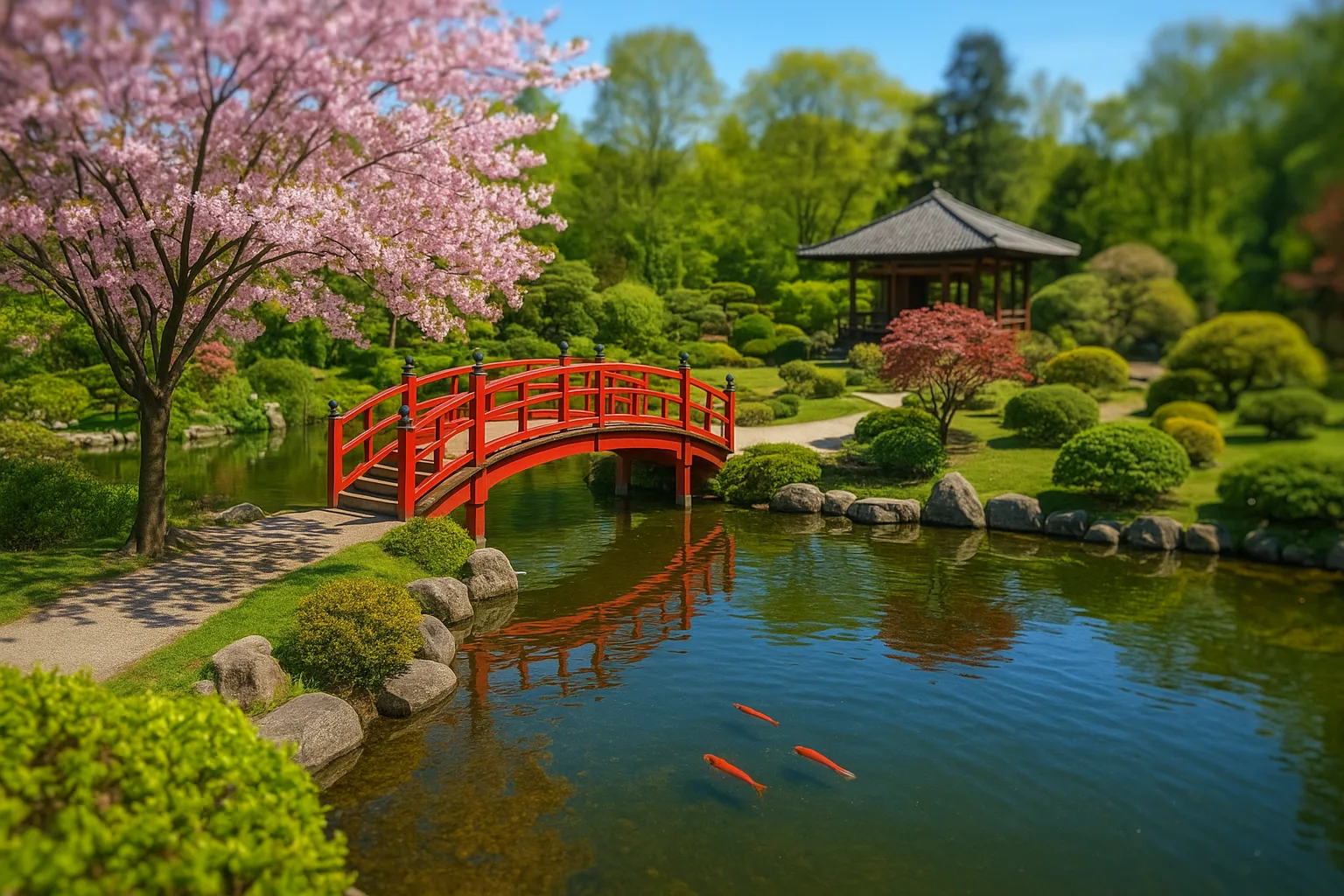
- The red bridge over the pond – the garden’s most iconic feature and the main photo spot, with views over the water and greenery.
- The koi pond – the central part of the layout, with reflections of plants and garden architecture.
- The tea pavilion – a light wooden structure that adds a clear architectural accent and organizes the surrounding views.
- Stone lanterns – placed near the water and along the paths, they shape the atmosphere and are among the most distinctive details.
- Water and bridge viewpoints – the best places to see the layered plant design, reflections and changing perspectives.
The best light for photography appears in the morning and late afternoon, when the sun is lower and highlights the texture of the plants and the surface of the water.
History of the Japanese Garden
The Japanese Garden was created between 1909 and 1913 as part of the grounds prepared for the Centennial Exhibition in Wrocław. The aim was to present an authentic Japanese-style garden, which is why specialists from Japan were invited to collaborate and the composition was based on traditional principles of Japanese garden art.
After the exhibition ended, the garden gradually lost its original character, and many elements were damaged or altered. A turning point came in the 1990s, when a comprehensive restoration began in cooperation with Japanese partners. The water system, bridges, pavilions and plant selection were reconstructed in line with the historical concept.
Shortly after reopening, the garden was severely damaged during the 1997 flood. Another restoration was necessary, and the garden reopened to visitors in 1999. Its current appearance is the result of this reconstruction.
Symbolism and layout of the garden
The garden’s composition is not random — every element has meaning and follows the principles of Japanese landscape design.
- Water – the central feature of the layout. The pond and streams introduce movement, light reflections and shifting views, while symbolizing life and transience.
- Stones – form the stable, “unchanging” structure of the composition. Their arrangement imitates a natural mountain landscape and defines key sightlines.
- Bridges – guide visitors through successive scenes and change the viewing perspective. Each crossing over water offers a different vantage point.
- Plants – shaped and arranged to appear natural throughout the year. The selected species emphasize seasonal change and variations in color.
The garden is meant to be experienced in motion — views unfold gradually, and the full composition is never visible from a single spot.
ℹ️ Practical information
| Address | 1 Adama Mickiewicza Street, Wrocław |
|---|---|
| Entrance | from the Pergola and Centennial Hall side |
| Visit duration | approx. 30–60 minutes (up to 1.5 hours at a relaxed pace) |
| Restrooms | near the Pergola and in the Centennial Hall area |
| Food & drinks | restaurants and cafés within the Centennial Hall complex and around the Pergola |


