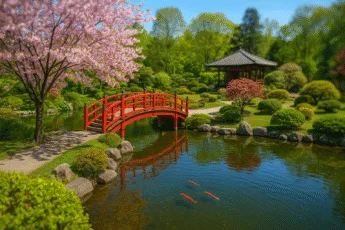
The Japanese Garden in Wrocław was created in the early 20th century as part of a larger park complex connected to the Centennial Exhibition. Its history includes the original construction period (1909–1913), the gradual loss of its original character, reconstruction in the 1990s, and significant damage caused by the 1997 flood.
1909–1913: creation of the garden
The Japanese Garden was designed and built between 1909 and 1913 as part of the grounds prepared for the Centennial Exhibition (1913), held in Wrocław (then Breslau). The exhibition commemorated the 100th anniversary of King Frederick William III’s proclamation “To My People.”
The garden project involved Count Fritz von Hochberg, a well-known enthusiast of Japanese culture. Japanese gardener Mankichi Arai was invited to collaborate and supervised the implementation of selected elements in accordance with traditional Japanese garden design principles.
The garden was intended to present authentic compositional solutions typical of Japanese landscapes: water as the central axis, bridges, stones, pavilions, and carefully selected plant species.
After 1913: changes and loss of original character
Following the Centennial Exhibition, the garden no longer served as a showcase installation. Over the following decades, its layout was altered, and some architectural and compositional elements were removed or destroyed. Gradually, the garden lost much of its original Japanese character.
The 1990s: reconstruction
In the early 1990s, a decision was made to restore the garden as closely as possible to its historic design. The reconstruction was carried out in cooperation with Japanese specialists. The water system, bridges, pavilions, and key architectural features were recreated in line with traditional Japanese composition principles.
The garden reopened to visitors in 1996.
The 1997 flood
In July 1997, Wrocław was hit by the so-called “Flood of the Millennium.” The Japanese Garden was severely inundated and damaged. Architectural structures, vegetation, and water infrastructure were all affected.
After the flood, another restoration effort was undertaken. The garden reopened to the public in 1999.
The garden today
The current appearance of the Japanese Garden reflects the 1990s reconstruction and the post-flood restoration works. The historic compositional layout has been preserved: the central pond, the waterfalls (Onna-daki and Otoko-daki), bridges (including Taiko Bashi and Yumedono Bashi), pavilions (Azumaya and Machiai), and gates (Sukiya-mon and Fuku-mon).
Today, the garden operates as a seasonal walking attraction within Szczytnicki Park and is considered one of the most recognizable Japanese-inspired garden layouts in Poland.